Delivered through our partner network · enterprise logos placed with permission





















Our AI Model Development Service helps businesses build custom AI models, automate complex processes, improve forecasting accuracy, and turn business data into measurable growth, efficiency, and competitive advantage.
The processes and business objectives of different industries may not be addressed by generic AI tools. Custom AI model development involves creating AI models tailored to your specific data and processes.
Manual reporting and decisions are still common in many business teams. Organizations that use data to make significant decisions are three times more likely to be highly data-driven as compared to others, according to PwC. Custom AI models enable leaders to act quickly, minimize delays, and discover opportunities ahead of the competition.
Firms are gathering information at a larger scale than they ever have before, but many of those bits and pieces go unused. Seagate discovered that almost 68% of organizations aren't using the data that's available to them. AI-powered solutions can help to turn that data into actionable insight, enabling growth, efficiency, and smarter business planning.
AI adoption is becoming a competitive necessity. Research from McKinsey shows that over 88% of companies are already using AI on a regular basis in at least one business process, almost double the percentage of those that did so just a few years ago. Businesses that don't adapt could be left behind by more agile businesses.
When tools are siloed, they become inefficient between departments and systems. According to Deloitte's research, integration challenges are among the biggest obstacles to successful AI implementation. In the absence of AI capabilities, companies frequently suffer from the lack of data harmonisation, disjointed workflows and poor ROI from technology investments.
There are many organizations that invest in AI, but they do not have metrics to measure their success. Only 25% of AI projects return their investment, reports IBM. A structured AI model lifecycle can help businesses tie model development, deployment and optimization to a business outcome.
Predict future trends, customer actions and risks with predictive analytics models based on your business data. Pave the way for proactive decision making, optimize planning, minimize risk and discovery growth before it affects performance, revenue, or customer satisfaction.
 01/ Natural Language Processing
Use natural language processing models to convert unstructured texts to business values, understanding customer feedback, documents, conversations, and support requests. Reduce response time, gain insights in real-time at scale, and automate language-based tasks to free employee resources.
 02/ Computer Vision System
Use computer vision technology to identify patterns, objects, faults and behaviors in images and video for the operations you're trying to solve. Enhance quality control, bolster security, automate inspections, and have quicker insight into processes that were previously overseen manually.
 03/ Generative A
Design sophisticated Generative AI applications and train large language models to fit your business goals, knowledge and workflows. Provide more precise results, enhance customer experience, and build intelligent solutions that offer valuable business value.
 04/Classification and Regression
Use complex classification and regression models to identify customer segments, predict outcomes and inform decision-making using data. Make more accurate predictions, minimise risk and empower teams to make faster decisions with trust in business intelligence.
 05/AI Agents
Create and execute complex workflows with AI agents that can interpret information, carry out actions and assist in decision-making throughout business functions. Eliminate repetitive tasks, boost efficiency, and develop scalable AI-driven solutions to free up the team's time for more value-added work.
 06/ AI Agents and Agentic Automation

Build custom AI models that solve real business challenges, improve operational efficiency, and create lasting competitive advantage with scalable solutions designed around your goals, data, and growth strategy.

Utilize trusted experts who have experience in building AI models, implementing machine learning, and delivering enterprise technology solutionss. All engagements are aligned to business goals from the outset to ensure expertise, quality delivery, and measurable outcomes.

Every stage of the AI model lifecycle including data preprocessing, model training, deployment, monitoring, and optimization, is managed with a structured approach that is focused on long-term business value and sustainable performance.

AI initiatives begin with defined business objectives that build towards better measurable outcomes (e.g., greater operational efficiency, increased customer satisfaction, greater revenue growth, reduced cost, or improved effectiveness) rather than just technical specifications.

Collaborate with professionals who know what technologies are best suited to your objectives and not a prefer a vendor ecosystem. Platforms like TensorFlow, Scikit-learn, Azure OpenAI, AWS Bedrock, or others could be used to develop solutions.

Governance, security and risk management support is provided during development and deployment. Solutions are built with compliance in mind to support businesses in meeting their compliance requirements, including ISO 27001 and industry-specific requirements.

We communicate effectively throughout the project, have clear timelines, deliverables and measures of success. Frequent progress reviews ensure alignment between the business objectives, the project development, and measurable outcomes throughout the project.
 01
01
Enhance diagnostic support, patient engagement, and operational efficiency using healthcare AI solutions. Studies indicate that AI-driven diagnostics can enhance the accuracy of detection by up to 94%, aiding healthcare providers in quicker and more informed clinical decisions.
 02
02
Improve the risk management process and identify suspicious activity in real time through machine learning models. AI-driven fraud detection systems can cut false positive rates by over 81.3%, enhancing security and customer satisfaction, industry reports show.
 03
03
Learn customer behavior, optimize inventory planning and personalize shopping experiences using AI-powered analytics. Convert business data to insights that boost conversions, enrich the customer experience and enable more informed merchandising decisions both online and offline.
 04
04
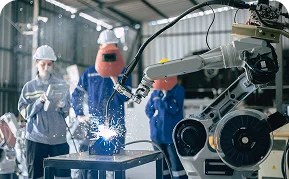
Optimize manufacturing operations with Manufacturing AI solutions to boost production efficiency and minimize disruptions. Forecast the defects from predictive analytics, computer vision and automated inspection to improve product quality and ensure consistent performance throughout manufacturing operations.
 05
05
Gain insight into market trends, pricing dynamics, and customer behavior with predictive models, making informed decisions about your investments and properties. Boost the accuracy of forecasts, minimize risk and identify opportunities that help grow the business over time.
 06
06
Enhance product experiences with AI-powered features such as intelligent recommendations, workflow automation, and predictive insights. Develop scalable AI solutions that enhance engagement with users, drive operational efficiency, and provide a significant competitive edge.
Whether you want to improve decision-making, automate operations, enhance customer experiences, or unlock the value of your data, our AI Model Development Service helps you move from ideas to measurable outcomes with confidence.

Long-form POVs, governance frameworks, and field benchmarks on what actually works in production healthcare AI. Hover to pause.

The structure, artifacts, and review cadence that satisfies TGA SaMD requirements without slowing deployment velocity.

How to connect AI systems to your EHR without creating data silos, compliance gaps, or HL7 translation nightmares.

The model design, data pipeline, and governance framework behind a validated predictive risk deployment at a regional hospital network.

A practitioner's reference for navigating overlapping privacy obligations when deploying AI across clinical data environments.

The five most common validation gaps that surface during post-go-live TGA audits — and how to close them before deployment.

Change management, privacy disclosure, and workflow design patterns from practices that achieved 70%+ documentation time reduction.

Why 60% of CDSS deployments are bypassed within 6 months — and the alert design and workflow integration principles that reverse it.

How one imaging network deployed AI-assisted triage across 8 sites while passing ARTG review and maintaining radiologist confidence.
The structure, artifacts, and review cadence that satisfies TGA SaMD requirements without slowing deployment velocity.
How to connect AI systems to your EHR without creating data silos, compliance gaps, or HL7 translation nightmares.
The model design, data pipeline, and governance framework behind a validated predictive risk deployment at a regional hospital network.
A practitioner's reference for navigating overlapping privacy obligations when deploying AI across clinical data environments.
The five most common validation gaps that surface during post-go-live TGA audits — and how to close them before deployment.
Change management, privacy disclosure, and workflow design patterns from practices that achieved 70%+ documentation time reduction.
Why 60% of CDSS deployments are bypassed within 6 months — and the alert design and workflow integration principles that reverse it.
How one imaging network deployed AI-assisted triage across 8 sites while passing ARTG review and maintaining radiologist confidence.
An AI model development service can assist a business in creating, building, training, testing, deploying, and optimizing AI systems for their unique objectives. Rather than using a single tool, organizations can build their own AI models that can be trained with their own data and processes. The models can be used for predictive analytics, automation of business processes, customer engagement, fraud detection, forecasting, natural language processing, computer vision, and more. This involves data assessment, model development, testing, deployment, monitoring and continuous improvement.
The project will be customized in terms of timelines depending on the complexity of the use case, availability of data, integration needs, and business goals. While smaller projects with a well-defined dataset can be completed in a few weeks, enterprise-level projects that involve multiple systems, more sophisticated machine learning models, or Generative AI capabilities may require several months. The key to a successful project is getting off on the right foot by taking time to set goals, consider feasibility, and set realistic project timelines.
The required data depends on the problem you want to solve. These are typically customer records, transaction history, operational data, customer support tickets, documents, images, videos, sensor data and application logs. Sometimes quality trumps quantity. At the initial assessment, existing data is analyzed to see if there is missing data, if it is ready, or if it requires further preprocessing, and/or addition, prior to model training.
Today's AI solutions are built to integrate with existing business systems rather than replacing them. Models can be linked to ERP systems, CRM applications, data warehouses, business intelligence applications, customer portals, mobile applications, and internal processes. When predictions, suggestions, and automated tasks seamlessly fit into the business workflow, it's a sign of effective AI integration.
AI consulting is more about strategy, planning, and opportunity assessment, and determining the value of AI within an organization. AI model development extends beyond creation and include developing, training, testing, deploying and maintaining the models that enable AI-driven capabilities. In simple terms, consulting helps define the roadmap, while AI model development turns that roadmap into operational solutions that generate measurable business outcomes.
Compliance considerations are incorporated throughout the entire project development process, as compared to being tackled at the end. Industry and use case dictate which data privacy, access control, data governance, auditability and security measures are in place. In regulated industries like healthcare and financial services, the solutions can be customized to meet compliance standards like HIPAA, GDPR, ISO 27001, and other applicable regulations, without sacrificing performance, scalability, and value for the business.