Delivered through our partner network · enterprise logos placed with permission























Our computer vision consulting services help businesses design and deploy AI systems for object detection, image classification, and video analytics using deep learning, machine learning, and production-ready computer vision solutions that deliver measurable business value.
The incorrect tools, models, or frameworks result in costly rebuilds and delays. According to research, technological and organizational issues are one of the leading reasons for the failure of AI projects, particularly if they aren't designed for scalability and integration in the long term.
In many cases, the computer vision project remains a proof-of-concept. According to Gartner, more than 40% of agentic AI projects will be paused by 2027. This can happen due to escalating costs, unclear business value, or inadequate risk controls.
If you do not know how to measure ROI on computer vision systems, they are frequently viewed as experiments. A lack of value frameworks is a common reason why organizations struggle to achieve enterprise-wide outcomes from AI pilots. IBM says just 25% AI projects achieve expected ROI.
Computer vision is highly reliant on good-quality labeled data in order for accurate results to be obtained. Gartner predicts that in 2026, organizations will abandon 60% of AI projects unsupported by AI-ready data, demonstrating how the lack of data pipelines and the lack of labels directly impact deployment speed and model performance.
According to Cisco's Data Privacy Benchmark Study, 94% of organizations say customers would not purchase from them if data is not properly protected. Startups can rely on responsible AI consulting to satisfy GDPR, CCPA, HIPAA and other compliance regulations from their initial stages.
There are no specialists in computer vision, deep learning, MLOps in most organizations. Gartner's 2026 survey found that 50% of supply chain leaders cite limited internal AI expertise and talent as a major challenge when implementing and managing AI systems, which highlights the growing skills gap across enterprises.
Evaluate business objectives, technical needs, and data to see if a computer vision system is feasible. Explore optimal applications like object detection, image classification, or video analytics, assess performance, risks, and potential return on investment (ROI), and make assessments before development starts.
 01/ CV Strategy
Develop a clear implementation roadmap for computer vision systems, such as the selection of the models, system architecture and deployment approach. Describe the relationship between deep learning, neural networks and machine learning elements to develop scalable production-ready computer vision solutions that deliver business value.
 02/ Implementation Roadmap
Assess current image and video databases to assess their quality, structure and usefulness. Create a good technique for annotating the object detection, segmentation and classification problems. Refine data pipelines to provide accurate, consistent and well-labeled data for models.
 03/ Data Audit
Understand the technical, operational and regulatory risks involved in the use of computer vision. Make sure standards are met including GDPR and HIPAA if applicable. Discuss issues with facial recognition, data privacy and bias to ensure responsible and safe use of AI.
 04/Risk Assessment
Estimate the overall cost and infrastructure requirements and development effort of computer vision systems. Carry out ROI analysis to quantify the potential impact of automation, efficiency, and predictive analytics on the business, enabling organizations to prioritize investments and minimize risks.
 05/Project Budgeting
Point out risk and cost associated with computer vision projects and help with Proof of Concept development to validate use cases for full scale deployment. Complete feasibility testing, model validation and performance benchmarking. Match businesses with appropriate technical partners for development and MLOps and production deployment support.
 06/ PoC Oversight

Turn visual data into business intelligence with computer vision consulting services that help you design, test, and deploy AI systems for real-world impact, efficiency, and measurable ROI.

Connect with a network of computer vision experts in the field of deep learning, object detection, image classification, and production deployment. This means that the technical team will always have the necessary skills required for the project, from strategy to execution.

No tool or model is selected until there has been a feasibility assessment, use case discovery and ROI analysis at the start of every engagement. This means that solutions will be aligned with business goals and not just because they can be technically complicated.

Solutions are developed to be vendor agnostic and flexible to not be locked into any frameworks or platforms. Companies have complete control of their computer vision system, data pipelines, and deployment environments.

Engagements are tailored to meet US regulatory and industry requirements, such as GDPR compliant data practices and healthcare privacy considerations when applicable. This guarantees safe and responsible use of AI.

All projects are assessed by well defined performance measures like accuracy, efficiency improvements, defect reduction and ROI. This makes business progress clear, measurable and productive.

The support process covers strategy and data preparation through deployment, MLOps, and model optimization. This helps computer vision systems to transition seamlessly from concept to a working product.
 01
01
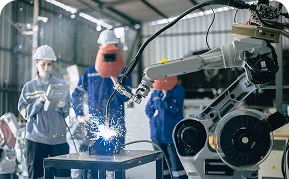
Computer vision is applied by manufacturers to detect defects, verify assembly, and validate quality. The 2025 Deloitte Smart Manufacturing Survey reveals that 78% of manufacturers are allocating over 20% of their improvement budgets to smart manufacturing broadly (sensors, cloud, analytics, AI) to enhance quality, productivity, and operational performance.
 02
02
Computer vision is applied to analyze X-rays, CT scans, MRIs and pathology images in healthcare organizations. Microsoft's AI Diagnostic Orchestrator showed 85% diagnostic accuracy on complex medical cases, significantly outperforming physicians in the study, highlighting the potential of AI-powered medical imaging and decision support.
 03
03
Customer behavior analysis, shelf monitoring and in-store analytics are examples of Retailer applications for computer vision. It provides instant access to foot traffic, product engagement and visual merchandising metrics, enhancing in-store customer experience and data-driven retail decision making.
 04
04
Computer vision has made a significant impact in logistics, enabling the automated tracking of items, monitoring of warehouses, and damage detection in packages. It enhances operational efficiency by minimizing manual checks and providing the ability to see the movement of goods throughout the supply chain in real time, which helps optimize the movement, storage, and delivery processes of the organization.
 05
05
Facial recognition and OCR are used by financial institutions to verify documents, detect fraud, and authenticate identities. These technologies can cut down on the manual work required, enhance security, and boost compliance in high-risk financial settings.
 06
06
Autonomous systems, driver assistance and autonomous systems such as object tracking and lane detection are all powered by computer vision through convolutional neural networks. It plays a crucial role in contemporary transportation systems, enhancing safety, navigation precision, and real-time decision-making in both vehicles and infrastructure.
Build, test, and deploy scalable computer vision solutions with expert consulting that improves accuracy, reduces manual effort, and delivers measurable ROI across your operations.

Long-form POVs, governance frameworks, and field benchmarks on what actually works in production healthcare AI. Hover to pause.

The structure, artifacts, and review cadence that satisfies TGA SaMD requirements without slowing deployment velocity.

How to connect AI systems to your EHR without creating data silos, compliance gaps, or HL7 translation nightmares.
The model design, data pipeline, and governance framework behind a validated predictive risk deployment at a regional hospital network.

A practitioner's reference for navigating overlapping privacy obligations when deploying AI across clinical data environments.

The five most common validation gaps that surface during post-go-live TGA audits — and how to close them before deployment.

Change management, privacy disclosure, and workflow design patterns from practices that achieved 70%+ documentation time reduction.

Why 60% of CDSS deployments are bypassed within 6 months — and the alert design and workflow integration principles that reverse it.

How one imaging network deployed AI-assisted triage across 8 sites while passing ARTG review and maintaining radiologist confidence.
The structure, artifacts, and review cadence that satisfies TGA SaMD requirements without slowing deployment velocity.
How to connect AI systems to your EHR without creating data silos, compliance gaps, or HL7 translation nightmares.
The model design, data pipeline, and governance framework behind a validated predictive risk deployment at a regional hospital network.
A practitioner's reference for navigating overlapping privacy obligations when deploying AI across clinical data environments.
The five most common validation gaps that surface during post-go-live TGA audits — and how to close them before deployment.
Change management, privacy disclosure, and workflow design patterns from practices that achieved 70%+ documentation time reduction.
Why 60% of CDSS deployments are bypassed within 6 months — and the alert design and workflow integration principles that reverse it.
How one imaging network deployed AI-assisted triage across 8 sites while passing ARTG review and maintaining radiologist confidence.
A computer vision consulting company is a firm that can assist organizations in the design and implementation of AI systems capable of understanding images and video. This includes the discovery of use cases, feasibility assessment, data preparation, model selection, system design and production deployment. The vision: to use technologies such as deep learning, object detection, and image classification to convert data that is largely visual to usable business insights.
The price is determined by the complexity of the project, the size of the data and their deployment requirements. Costs for a small proof of concept project can be in the tens of thousands of dollars, and for full-scale enterprise computer vision systems with cloud deployment, MLOps, and integration, budgets can be much higher. Typically, pricing is determined by the scope, timeframe and accuracy desired.
The timelines are based on the use case and technical complexity. The duration of a basic feasibility study that involves only data labeling, model training, testing and deployment of full production systems may take several months. Longer cycles may be required for more advanced systems with real-time processing or for edge deployment.
The industries that can gain the most benefit from visual data, such as manufacturing, healthcare, retail, logistics, finance, and automotive. The industries are leveraging computer vision in quality control, medical imaging, fraud prevention, warehouse inventory management and autonomous systems to enhance efficiency, precision, and decision making.
Most of the computer vision solutions are built to seamlessly connect to the existing ERP systems, cloud platforms, and enterprise data pipelines. Data is usually integrated via APIs, data connectors, or cloud services such as AWS, Azure, or Google Cloud, which helps to ensure seamless data flow without causing any disruption in the existing workflow.
Computer vision consulting involves strategy, planning, feasibility and design of a computer vision solution, and computer vision development involves the actual construction and deployment of the models and systems. Consulting is about determining the proper approach, architecture and ROI while development is about the implementation, coding, training and production deployment.